

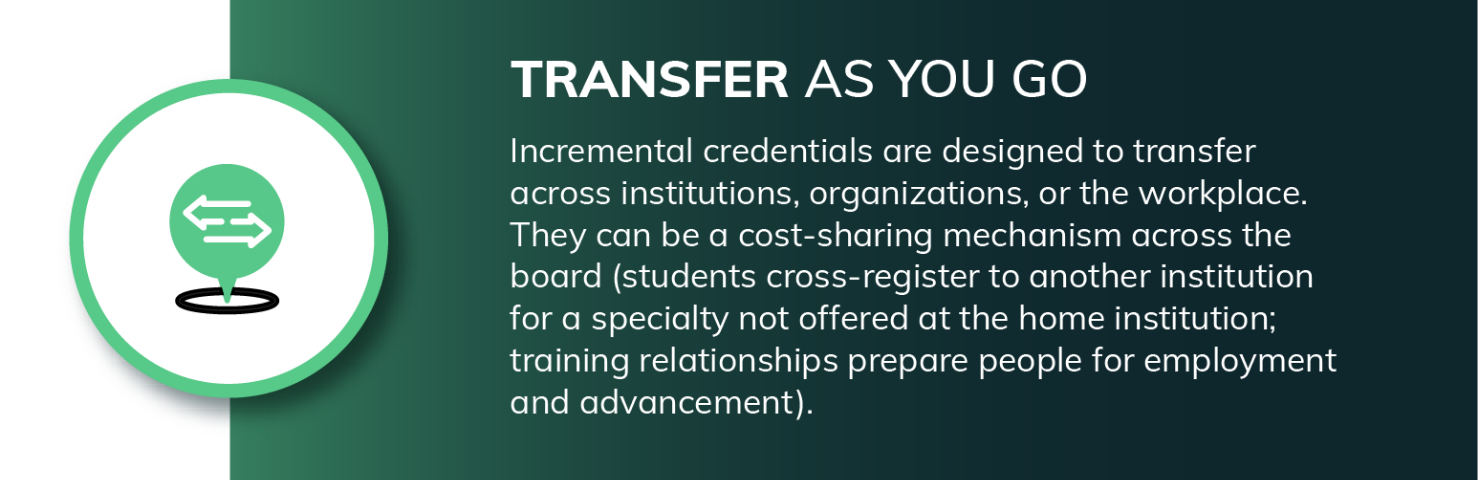
Transfer As You Go credentials are designed to be transferable across multiple higher education institutions and academic programs. These credentials can be sequential, allowing learners to progress to the next level of credential, or transferable across different programs at the same level. Transfer credentials can offer cost-sharing benefits when shared across different institutions or programs. The integrated pathways developed by transfer credentials help learners persist and complete their education. Additionally, these credentials provide clear and transparent options for learners to gain the necessary skills for work and academic advancement.
TransferBOOST, a pilot initiative launched in 2021 by the Institute for Higher Education Policy and HCM Strategists, worked across three states and 24 institutions to address transfer challenges. The program focuses on supporting Black, Latina/Latino, Indigenous, and AANHPI students and students from low-income backgrounds who are disproportionately affected by the broken transfer system. It seeks to remove barriers in the transfer system by clearly communicating and supporting community college students through a mapped pathway, streamlining time to degree, and providing clear costs. The program emphasizes the importance of committed leadership and consistency in the review of data to increase transfer success among these students.
The initiative started with an analysis of early indicators of student behaviors, experiences, and outcomes. It also examined institutions’ communication and marketing strategies to determine what is effective for which students. Participating schools also reviewed policies for unintended consequences and barriers, such as setting arbitrary GPA requirements for scholarships or transfer pathways. The report on the pilot initiative details five lessons learned:
Related work/initiatives: